

Internships are a relatively low-stakes, high-yield opportunity for people to boost their careers, but they aren’t easy to come by. One surefire way of securing internships at even the most unusual times of the year is cold emailing. So, today, we’re going to show you how to cold email for an internship!
Now, we all know about the basics of hunting for internships (and jobs in general). There are a few steps involved, including creating a contact list for opportunities, designing the perfect resume, and optimizing your LinkedIn profile. You can read more about that here.
But if you’ve got all the initial steps down already, let’s dive into cold emailing, starting with the definition.
If a company puts out a call looking for candidates to fill a job role and you respond to it, that isn’t cold emailing. A cold email is defined as an UNSOLICITED email, a ‘first contact’ of sorts, stating a request with hopes to obtain some form of benefit from it.
In this case, you’re reaching out to a person who doesn’t know you, introducing yourself, requesting an internship and hoping they get back to you. It’s a good form of networking that will help you reach those at higher levels of the organization in a professional manner, but there is … a certain etiquette that you must adhere to. If you don’t, you’ll wind up hurting your chances of getting the internship rather than improving them.
Basic preparation
Now, the worst mistake you can make it be haphazard about this process. It takes some planning, organizing and analyzing to make sure your cold emailing spree ends up fruitful.
First, let’s talk about expectations. The chances of you sending one or two emails and immediately getting an internship are very low. You’ll have to send several emails.
But this doesn’t mean just randomly Googling lists of companies and bombarding them with emails. You’ll have to do some sleuthing.
What to consider when shortlisting companies to cold email:
1. What is the objective of this internship? Are you looking for a gateway into a particular field of interest? Are you a student looking to fill in your summer vacation or add some experience to your resume? Are you looking to switch careers and need a new starting point? Ask yourself these questions and figure out what exactly is the main goal of this internship.
2. How can this company help you further your goal? If you want to upskill, is this company a good place to intern at? Do they have adequate resources to make time for you? Are they recognized in the industry you’re interested in?
3. The company’s size matters. Larger companies tend to have strict windows when they’re onboarding interns. You’ll have to track these windows by paying close attention to the dates and preparing ahead of time. Smaller companies, especially startups, tend to be more flexible. In addition, they may not have all the resources of a large, well-established company, but they can offer more one-to-one opportunities to learn. Startups also function in an environment that’s constantly changing, so you’ll be expected to quickly gain some independence and keep up with the pace.
4. What are you bringing to the table? What reason would they have to dedicate time and resources to train you during your internship? With interns, they aren’t required to have a ton of experience or all the technical skills for a job role; but having initiative, passion, and soft skills matters!
Get organized
Now that you know what you’re looking for, it should be a lot easier to find the right companies that are worth emailing to. LinkedIn is a great resource for this. You can find the appropriate people to email on LinkedIn and their contact details, too.
People tend to make the mistake of immediately emailing the CEO or some extremely OP figure in a company. Try to avoid this. There are some exceptional cases, like smaller companies with teams of 5-6 people. In such cases, you’re more likely to be able to get a response from the higher-ups if you do reach out to them.
If you want to intern in the digital marketing department, look up the department head on LinkedIn. See if you can gather some information about them, what they do, etc., from their posts and interactions. You can utilize this to show them you’ve done your research.
Next, once you have their details, you need to keep track of who you’re emailing, for what role, and what their response was. For this, you’ll need a sheet.
Here is a free template! Use this to track the details of the companies you’re eyeing, the contact person you’ve reached out to, the date you emailed them, and their response to your email.
Making contact
Remember, you’re still reaching out to a complete stranger. There’s a fine line between being persuasive and plain annoying. Everything from your tone, the information you provide, and the way you request an internship matters.
Take a look at the example below. Take a minute to read it and then think about what about this email you feel works and what doesn’t.
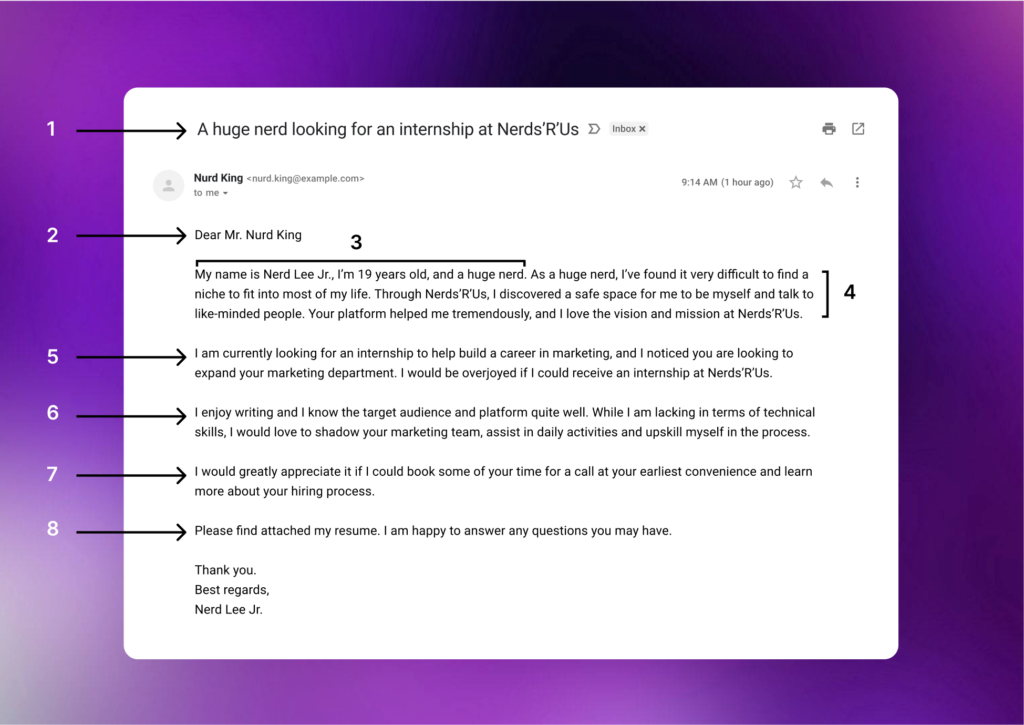
This is a relatively concise email, with 8 key points included.
1. Catchy subject line: a good subject line will help you stand out in the sea of emails they likely have piling up in their inbox. But context matters! A funny subject line works for a fun company. If you’re applying for a serious role, like at a law department, avoid trying to use humour to garner their attention.
2. Personalized greeting: Show that you’re acknowledging the person you’re emailing as a PERSON. Use their name, but don’t use their FULL name. It comes of as robotic and not very friendly. For example, stating ‘Hello Mr. Nurd Steven P. King’ would’ve been borderline creepy …
3. Short intro of yourself: Do NOT tell them your whole life story. Short and sweet. Name, maybe age if it’s relevant, and a short descriptor of either what your interest/main skill is to give them an idea of who you are.
4. Any experience you’ve had with this company: Essentially a way to show that you’ve got some personal experience with this company’s services and/or products. If you don’t have any experience, do some research about what they do and perhaps add a message lauding their work (but don’t overdo it).
5. State why you’re reaching out to them plainly: Incorporate some of the extensive research you’ve carried out on the company. This shows that you’ve taken the time to read up on them.
6. The internship proposal: Again, don’t try to sell yourself too hard. Be honest and keep it simple when informing them of what you bring to the table. If they have any noticeable pain points that you believe you can address, you can utilize this space to modestly highlight the benefits you’ll be adding.
7. CTA: A simple and polite CTA is a good way to signal you’re expecting a response from them. Leave some wiggle room without giving them any strict deadlines to get back to you or else you may come off as rude and pushy.
8. Resume/CV: Finally, let them know you’ve attached your resume (or CV, as we call it from across the pond). There is no point asking for an internship if you can’t give them the opportunity to learn more about your qualifications. And, it’s ideal to link in your LinkedIn profile on your CV so they can find you with ease.
Now, considering that you’re probably going to be sending out 20-30 emails (or even more), you might be tempted to use a template. Don’t get us wrong. Templates are very, very useful, but we must answer this question: should you use a cold emailing template?
To put it simply, no. You shouldn’t. It’s a lot better to use a template for inspiration purposes and craft something unique and customized to each company. Trust us, it shows. We’ve received emails before that were clearly Frankenstein-ed. It’s often quite noticeable when you’ve cut and patched together a message intended for somebody else.
If you want to nail your chances, take a couple of minutes to make it unique for each company. You’ll be strengthening your chances by a lot.
A quick test
So, now you know what you need to consider and do at every stage of cold emailing for internships. But let’s do a quick test to see if you’ve got it all down!
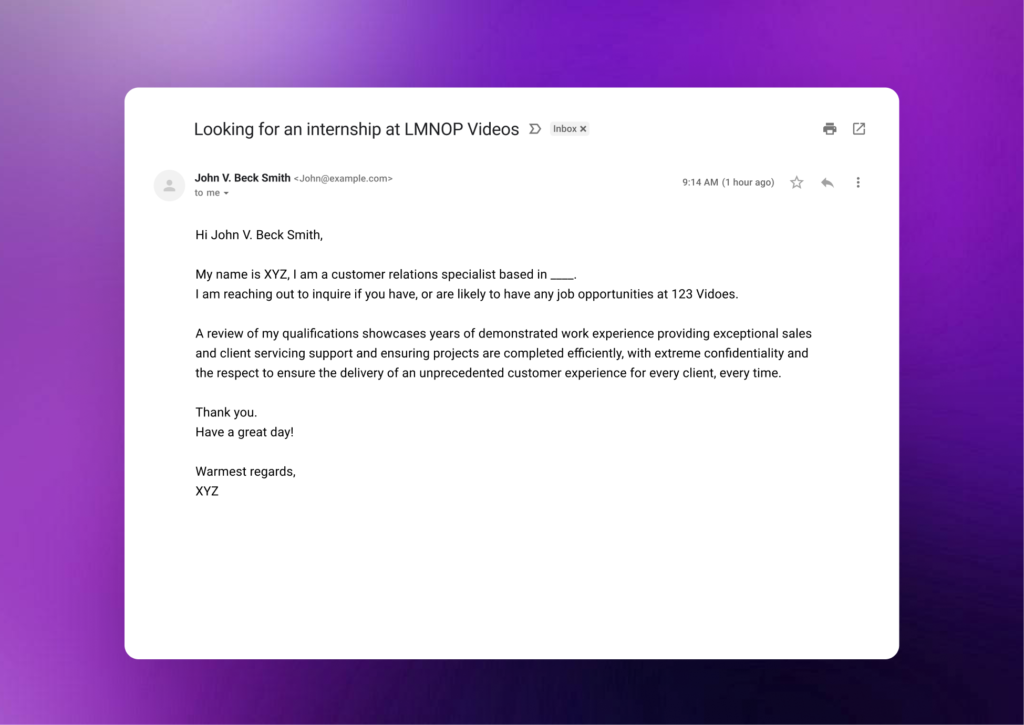
Take a look at the email in the image below. Is it bad? Is it good? What are your thoughts?
Think about what can be improved, and also think about what irked you about this. You can scroll down once you’re ready to read our thoughts on it.
Are you ready?
Okay, so there are a few problems with this email. For starters, the subject line is very boring and could easily be ignored. Think about it. When you’ve got dozens of random spammy emails in your inbox, it’s the ones with the most attractive subject lines that make you click on them.
Secondly, they’ve clearly copy-pasted an email meant for a different company here. This is a shockingly common occurrence and one that could’ve been easily avoided. Make sure to double-check the name of the company, the role you’re looking for, and the person you’re reaching out to.
Next, it’s such a vague email. While they state they’re a customer relations specialist, they’ve simply talked about what they’ve already done in their career thus far. If they’re looking for an internship, there should be a specific goal they want out of that internship highlighted in the email.
Additionally, there is no CTA nor a resume attached for the reader to go through to make up for the lack of information in this email or to follow through with the next course of action — which would usually be setting up a call to discuss this internship proposal further.
Final thoughts
It’s no doubt that cold emailing for internships has many benefits. It’s a largely underutilized method of job hunting and even if you don’t end up getting the internship, you can still opt to request advice from this new contact you’ve made.
It, unfortunately, doesn’t guarantee an internship, but it’s definitely a solid way to boost your network in a field you’re interested in, learn more about the companies in that sector, and also give yourself a fighting chance.
All we can say for certain is that, don’t give up! Keep trying, and your efforts will eventually pay off!


